


How I Recreated 2000s Sounds in Serum 2

The 2000s were the years when electronic music, Hip-Hop, R&B and Pop went through a huge transformation. VST instruments became increasingly common, production became more accessible, and many of the sounds that defined the decade were created inside computers rather than coming from a single piece of hardware.
For me, the 2000s are also personal.
I'm 40 years old, so these are the sounds that were part of my musical life. They are deeply connected to what I listened to, what influenced me as a producer, and what I still hear in my head when I think about that era.
Over the last few years, I've also noticed a growing interest in 2000s sounds and aesthetics. That made me want to approach the era the same way I approached my 90's Vibes project: not simply creating sounds that feel "retro", but trying to recreate the sounds that actually defined the decade.
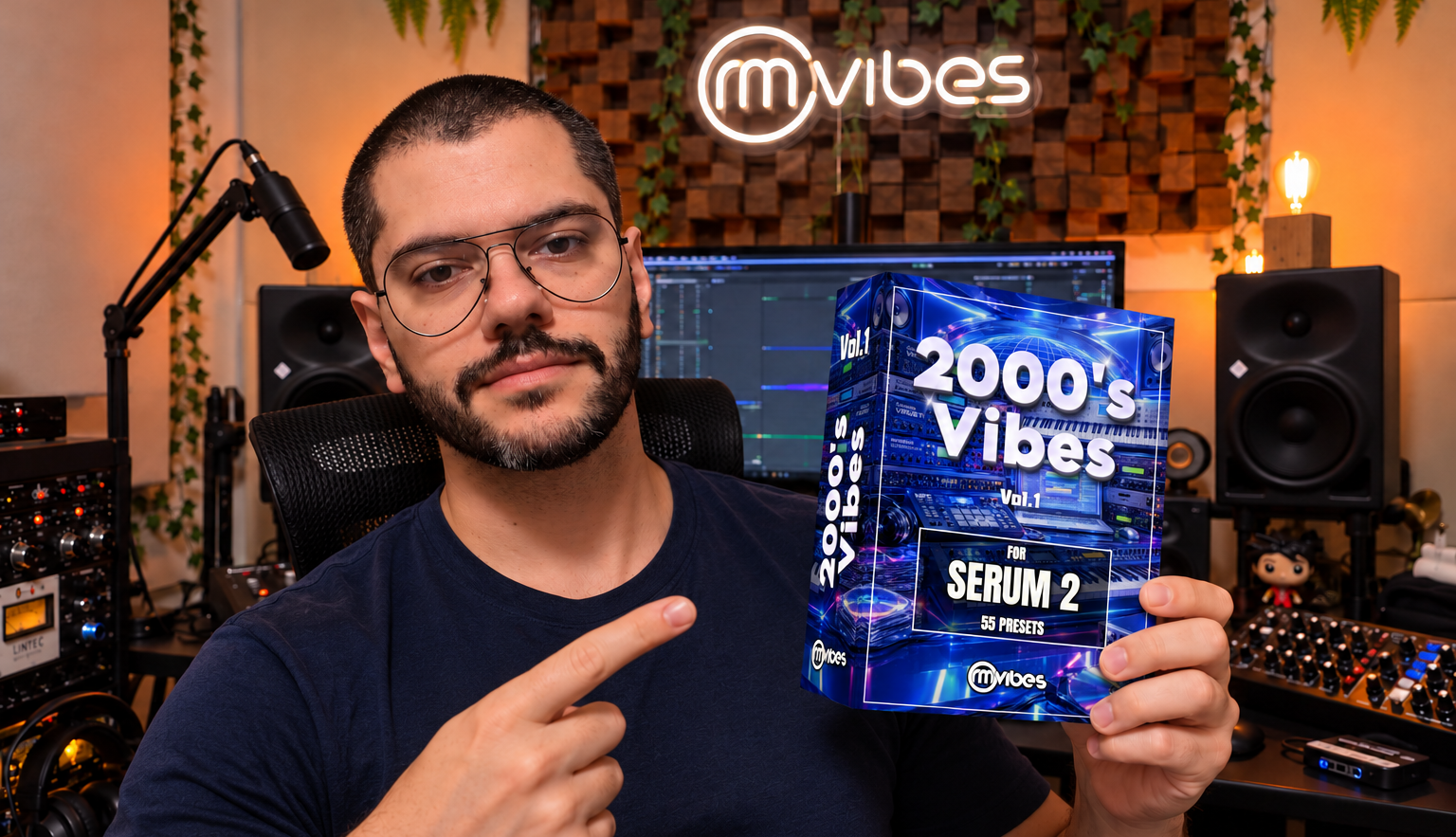
That's how 2000's Vibes for Serum 2 was born.
Why I Wanted to Recreate the Real 2000s Sound
My goal was simple: fidelity.
I didn't want to make a collection of modern presets with a vague 2000s character. I wanted to go back to the sounds that people actually remember.
The basses, leads, plucks and melodic sounds that were everywhere in electronic music, Hip-Hop, R&B and Pop during that period.
Instead of asking myself: "What would a 2000s-inspired preset sound like?" I asked: "What exactly am I hearing in this record, and how can I recreate it in Serum 2?"
That change in approach became one of the most important parts of the entire project.
Why I Used the Original Songs as My Reference
When I created 90's Vibes, hardware played a much bigger role in the process. Synthesizers such as the TB-303, Yamaha TX81Z and Korg M1 were important references because the sound of those instruments was deeply connected to the production of that era.
The 2000s were different.
By this time, producers were increasingly using VST instruments and software-based production. The sound of a record wasn't necessarily connected to one particular analog synthesizer that could simply be identified and recreated.
So instead of focusing on the question of which hardware created the sound, I focused on the actual records.
The songs themselves became my reference.
I listened to the original sounds, analyzed what I was hearing and then worked backwards to recreate them in Serum 2.
For this project, the reference wasn't a synthesizer. The reference was the music.
Recreating the Sounds of Iconic 2000s Tracks
The 2000s produced an enormous number of sounds that became instantly recognizable.
Electronic music had huge club records and increasingly aggressive synths. Hip-Hop and R&B developed extremely recognizable basses, leads and melodic sounds. Pop productions absorbed many of these ideas and brought them to an even larger audience.
I used songs from different parts of that musical landscape as references.
The goal wasn't to reproduce an entire song. It was to isolate the sounds that made those productions memorable and understand what made each one work.
Some of the references included sounds from tracks such as Alex Gaudino – Destination Calabria, Alice Deejay – Better Off Alone, Benny Benassi – Satisfaction, Darude – Sandstorm, Ida Corr vs. Fedde Le Grand – Let Me Think About It, Deadmau5 – Ghosts 'n' Stuff, Dr. Dre feat. Snoop Dogg – The Next Episode, Soulja Boy – Crank That, Usher feat. Lil Jon & Ludacris – Yeah!, Justin Timberlake feat. Timbaland – SexyBack, Kesha – TiK ToK, Lady Gaga – Just Dance, and many others.
Recreating 2000s Sounds in Serum 2
The sound-design techniques I used were very similar to those I used for 90's Vibes.
I worked extensively with Wavetables, Samples, FM synthesis, Serum 2's Matrix, LFOs, Envelopes, Unison, Filtering and Distortion.
The important part wasn't simply using these tools. It was using them to get as close as possible to the reference.
Serum 2 gives me enough control to manipulate the harmonic content, movement, dynamics and character of a sound until it starts behaving like the original reference.
Sometimes that meant starting from a waveform. Sometimes a sample was a better starting point. And sometimes I had to create the waveform myself, adding each harmonic individually.
The Leads That Define the 2000s
If I had to choose just one category that represents the heart of 2000's Vibes, it would be the Leads.
That's because, although not every song from the era was built around a lead, so many of the most memorable 2000s tracks had a lead sound that became part of the identity of the song.
For me, these sounds are probably the most nostalgic part of the entire pack.
There are 23 Leads in 2000's Vibes, and I spent a lot of time making sure each one captured the character of the original reference. These aren't simply synth sounds that happen to fit a 2000s aesthetic. They are sounds designed to trigger that immediate feeling of recognition.
You hear one of them and you might not even need to think about which song it came from.
You just feel it.
That's what makes these sounds so special to me. Some of them can bring back an entire period of your life in just a few seconds.
And honestly, when I play some of these leads, it's hard not to get chills.
That emotional connection was one of the main things I wanted to preserve when recreating them in Serum 2. The technical side of the sound design matters, but the final result has to carry the same feeling as the original.
If I had to pick one category from the entire pack to represent what 2000's Vibes is really about, it would be the Leads.
Recreating Iconic Sounds From the Original Records
Some sounds were particularly interesting because they are immediately recognizable when you hear the original track.
For example, I recreated the bass from Let Me Think About It, the sax sound from Destination Calabria, the characteristic melodic sound from Crank That, and guitar sounds associated with Let Me Think About It and The Next Episode.
These weren't chosen because they were technically impressive synthesizer patches. They were chosen because people remember them.
The purpose of the pack was not to demonstrate how complicated a Serum patch can be. It was to recreate sounds that already have a place in people's musical memory.
Leads, Plucks, Keys and Pads
The pack contains 16 Bass, 23 Leads, 9 Plucks and 7 Keys, for a total of 55 Serum 2 presets.
The large number of Leads reflects just how important lead sounds were to the electronic music of the period.
But I didn't want to fill the pack with dozens of variations of essentially the same sound.
Curation was extremely important.
Every preset had to justify its place in the collection.
Using Samples When the Original Sound Called for It
One of the biggest advantages of working from the original records was recognizing when synthesis alone wasn't necessarily the right answer.
For some sounds, the original character was much easier to reproduce by working from a sample.
I used this approach for several recognizable sounds from the references, including the sax from Destination Calabria and other sampled or sample-derived elements.
The objective was always the same: use whatever technique gets closest to the original sound.
There is no point in making a synthesis patch more complicated just to avoid using a sample if the sample is what gives you the correct character.
Keeping the Presets Mix-Ready
Just like with 90's Vibes, I didn't want these presets to sound great only when played solo.
They need to work inside an actual production.
I used the same general approach to processing, including the Serum 2 Bus, EQ and reverb where necessary, followed by a limiter to keep the output controlled and consistent.
The limiter is not there to replace proper mixing. It is there so that the presets have a predictable, usable output level when you browse through the pack.
The goal is simple: load the preset, play it, and immediately hear something that works.
The Reference MIDI Is Part of the Experience
Another important part of the pack is the MIDI preview.
Each preset has a MIDI performance designed to demonstrate the sound in context, following the same philosophy I used for 90's Vibes.
This matters because a sound can feel completely different when you hear it playing the type of musical phrase for which it was originally designed.
Instead of hearing: "Here's a preset." you get much closer to: "Here's the sound in the musical context that inspired it."
That makes it much easier to understand why the sound works.
The Same Sound Design Philosophy as 90's Vibes
Although the reference material changed, my philosophy didn't.
I still wanted the presets to be faithful to the reference, musically useful, easy to control, mix-ready and carefully curated.
Macros were also designed with the same philosophy.
I don't add controls simply because a preset can have them. If a macro provides a useful range while keeping the character of the original sound, it makes sense.
If pushing a control too far destroys the character I was trying to recreate, I would rather keep the preset focused.
More controls don't automatically mean a better preset.
Why Fidelity and Curation Matter
One of the biggest things I wanted to achieve with 2000's Vibes was to avoid filling a preset pack with sounds that are merely "inspired by" an era.
There are countless ways to make a sound feel nostalgic. That's not particularly difficult.
The difficult part is hearing a sound in a record and getting close enough that someone who remembers the original immediately recognizes what you were trying to recreate.
That's where I spent most of my attention.
I listened. I compared. I adjusted. And I kept refining the sounds until they felt right.
When a Preset Becomes “Scary Accurate”
This is probably the best feedback I've received about the pack.
A producer described the sounds as: "scary accurate."
And honestly, that's exactly what I was trying to achieve.
The fact that most of the presets made me personally very satisfied with how close they became to the references was one of the most rewarding parts of creating the pack.
The goal wasn't to make someone think: "That sounds like a 2000s preset." The goal was to make them think: "Wait... I know this sound."
That's a completely different reaction.
55 Serum 2 Presets Inspired by the 2000s
The final collection contains 55 carefully selected Serum 2 presets: 16 Bass, 23 Leads, 9 Plucks and 7 Keys.
The sounds cover the different musical worlds that shaped the decade, from electronic music and dance records to Hip-Hop, R&B and Pop.
The selection was intentionally limited. I would rather have a smaller collection where every preset deserves to be there than a huge pack filled with variations that don't add anything new.
What I Want You to Feel When You Play These Sounds
Ultimately, I want something very simple to happen when you open 2000's Vibes.
I want you to feel like you went back to the 2000s, but now you have those sounds inside Serum 2.
Not just sounds that have a vintage filter or a nostalgic label.
The actual character of the music that shaped that period.
For me, these sounds are personal. I'm 40 years old, and this was the music I grew up listening to.
That's why I didn't approach this project as a generic retro sound-design exercise.
I approached it as a producer trying to recreate sounds that are still in his head — and in his heart — decades later.
2000's Vibes for Serum 2
2000's Vibes contains 55 carefully curated Serum 2 presets based on the sounds and productions that defined the era.
The focus is on fidelity, musical usefulness and curation, with sounds recreated from actual 2000s records rather than simply given a generic "retro" character.
Final Thoughts
The 2000s were a fascinating period for music production because the technology was changing so quickly.
Hardware was still everywhere, but software instruments were becoming increasingly important. Producers were discovering new possibilities inside their computers, and many of those sounds became the defining sounds of an entire generation.
That's what made this project so interesting to me.
Instead of recreating a particular synthesizer, I could go directly to the source: the records.
And then ask a much more interesting question: Can I recreate what I actually hear?
That was the challenge behind 2000's Vibes.
And when a producer tells me the result is "scary accurate," I know I was heading in the right direction.
Explore 2000's Vibes for Serum 2.


Comments