


The Ultimate Guide to Ableton Effect Racks for Electronic Music Production

Updated: 5 days ago
What Is an Ableton Effect Rack?
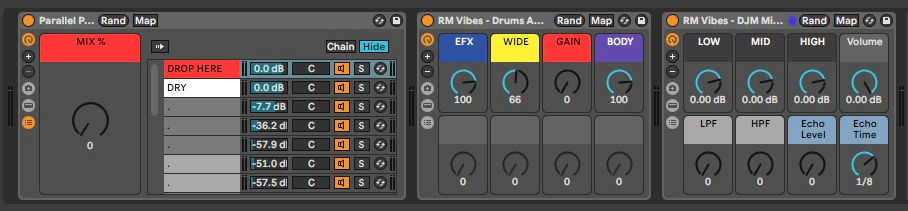
An Ableton Effect Rack is a way of combining multiple Ableton Live devices into a single, organized tool. Instead of working with several separate plugins and controls, a Rack can bring the important parameters together through macros. This makes complex processing much faster to control and repeat.
Why I Prefer Purpose-Built Racks
I don't create Racks simply to put several effects inside one container. The idea is to solve a specific production problem or make a specific workflow faster. That can mean controlling the low end, managing stereo information, shaping phase, creating DJ effects, or even generating sounds.
The products on RM Vibes are built around that idea: fewer controls, but controls that actually matter.
Ableton Effect Racks for Low-End and Bass
Low-end processing is one of the areas where a well-designed Rack can make a big difference. TH Bass Designer is designed to give you direct control over the character, weight and movement of a bass sound, with controls for waveform blend, sub, harmonics, phase, envelope, saturation and output.
Low Shaper takes a different approach, combining peak control, low-end shaping and saturation in a compact interface. It includes clean and dirty modes so you can move from a more transparent workflow to a more aggressive bass-shaping approach.
Phase and Stereo Processing
Phase is another area where small changes can have a surprisingly large effect on the final sound.
Total Phase Control combines several tools for phase manipulation, including phase rotation, crossover-based phase processing and micro-delay between the left and right channels.
This type of processing can be useful for kick and sub alignment, low-end control, headroom recovery and stereo processing.
Making Stereo Width Useful Instead of Just Wide
Stereo width is easy to overdo. Making something wider doesn't automatically make it better.
Stereoize is designed to create stereo information from a mono source while keeping a mono core intact. The Rack includes different approaches, including standard, multiband, Safe Chorus and simple versions.
Dynamic Processing and Frequency Masking
One of the most useful applications for intelligent processing is dealing with frequency conflicts between instruments.
Vocal SideChain was designed specifically around this problem. Instead of simply ducking the entire instrument with broadband sidechain compression, it dynamically attenuates the midrange where the vocal and instrument are competing.
The Rack also uses Mid/Side behavior so that a mono vocal can prioritize the center while wider instruments can be reduced more toward the sides.
Dynamic EQs takes another approach, combining native Ableton tools to provide dynamic EQ functionality through dual-band and dual-shelf configurations.
Phase-Based Tonal Shaping
Phase processing isn't only about fixing technical problems. It can also change how a sound feels.
Phase Maximizer was inspired by analog phase-alignment processors and uses frequency splitting and phase processing to bring out detail and definition.
This can be particularly useful on kicks, drum loops, synths and other material where you want to change the perceived clarity and impact without simply adding more EQ.
Clipping, Saturation and Loudness
Another area where a dedicated Rack can speed things up is clipping and level control.
Clipper 2 combines clipping, filtering, dry/wet control and input/output gain in a native Ableton Live 12 Rack.
The goal isn't to replace every dedicated mastering processor. It's to have a lightweight tool available when you need fast control over peaks, punch and character.
Ableton Racks for DJ Performance
Some of my Racks are designed specifically around DJ workflows rather than traditional studio processing.
DJM Effects brings Pioneer DJM-style effects into Ableton, including Beat Repeat, Echo, filters, Crush, Reverb, White Noise and a Scratch Mode.
DJM Mixer recreates the EQ behavior of Pioneer DJM mixers inside Ableton, including their frequency points and curves, while also adding filtering and echo controls.
DJ Easy Mix is focused on recording DJ mixes quickly, with controls designed to simplify bass and volume transitions.
Creating Sounds Instead of Just Processing Them
Not every Rack needs to be an audio processor. Some of the most interesting Ableton tools can actually be instruments or sound-generation systems.
Riser FX is an example: it generates risers, downlifters, sweeps and noise-based transition effects directly inside Ableton Live 12, allowing you to shape the result instead of relying on a static sample.
I also create Instrument Racks from hardware and classic instruments. ARP Solina String is a multisampled Instrument Rack based on an original ARP Solina String Ensemble, while M1 Piano and M1 Organ Bass recreate classic Korg M1 sounds using Ableton's native sampling tools.
What Makes a Professional Ableton Effect Rack?
For me, a professional Rack isn't defined by how many effects it contains. It's defined by how useful it is.
A good Rack should have a clear purpose, logical controls, useful macro mapping and predictable results.
It should also make sense inside a real production. If a control looks impressive but doesn't give you a useful range, I would rather remove it than add complexity just for the sake of having more parameters.
This is also why many of my Racks include output control or limiting when appropriate. The goal is to make the tool easier to use in an actual workflow, not just impressive when demonstrated in isolation.
Why I Use Native Ableton Devices
A large part of the RM Vibes approach is using Ableton's own devices whenever possible.
That keeps the Racks lightweight, avoids unnecessary third-party dependencies and makes them easier to integrate into an Ableton-based workflow.
Some products also use Max for Live where it provides functionality that native audio devices cannot offer, such as the phase-rotation tools in Total Phase Control.
My Approach to Ableton Effect Racks
My goal when building a Rack is usually very simple: identify a task that takes too many steps, understand what actually matters, and turn that process into a more direct workflow.
That's why the Racks cover very different areas — from bass design and phase processing to DJ effects, vocal control, stereo processing and sound creation.
The common idea is workflow. The Rack should help you get to a useful result faster.
Ableton Effect Racks by RM Vibes
RM Vibes offers Ableton Live Racks, Instrument Racks and Drum Kits designed around practical production and performance workflows.
The collection includes tools for bass design, phase and stereo processing, dynamic control, DJ performance, sound creation and mix checking.
You can explore the full collection of Ableton Effect Racks and related Ableton products on the RM Vibes website.
Final Thoughts
Ableton Effect Racks are most useful when they solve a real problem. They can turn a complicated chain into a few meaningful controls, make a repetitive task faster, or give you a completely different way to approach sound design.
The goal isn't to give you more plugins. It's to give you better tools for making music.
FORMATTING NOTE: Os títulos estão como Heading 2 e os trechos em negrito mostram exatamente onde marquei ênfase para o post.



Comments